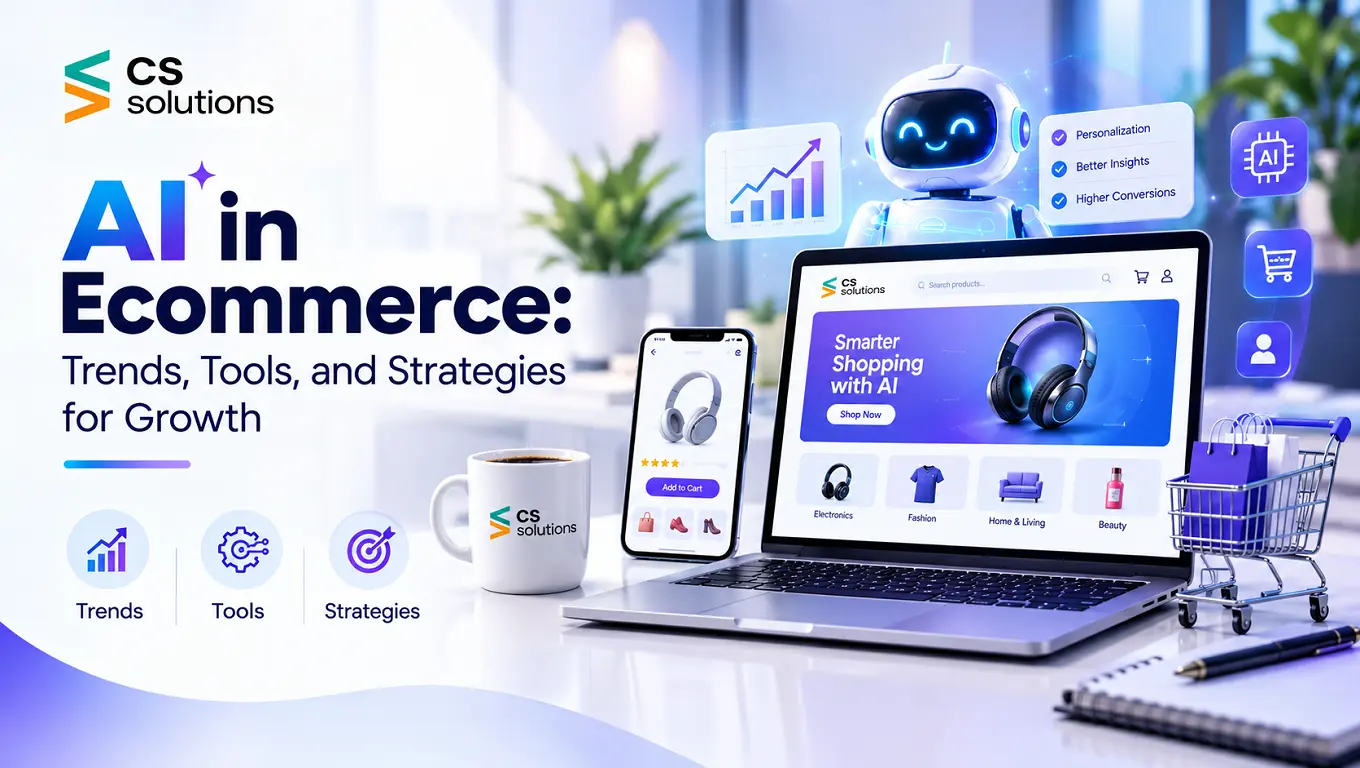
AI in ecommerce now starts working before shoppers reach your site. They ask an assistant what to buy, compare a few options in the chat, and arrive ready to check out. Protocols like UCP and ACP let AI agents finish the purchase too. Retailers are keeping pace, adding AI to search, support, and operations.
Clean product data and a clear plan decide who benefits. They also power the AI SEO services Toronto retailers use to turn ecommerce AI into sales. This guide covers the trends shaping 2026, the tools worth your budget, and a practical strategy for growth.
What is AI in Ecommerce, and How is it Different in Upcoming Years?
AI in ecommerce is artificial intelligence applied to how people shop and how stores run, from marketing and merchandising to inventory. It now sits between customer intent and your products. Salesforce found agentic search as a first shopping step grew 200% in a year, making AI for ecommerce businesses a visibility priority for any SEO company Mississauga retailers hire.
| Traditional Ecommerce AI | AI in Ecommerce Today (2026) |
| Scripted FAQ bot | Shopping assistant that holds a real conversation |
| Generic product suggestions | Personalization based on live context |
| Exact-match keyword search | Search that understands meaning and natural questions |
| Product descriptions written by hand | Content drafted with AI support |
| Reports on past performance | Forecasts that predict what comes next |
| Discovery that starts on your website | Discovery that starts inside AI tools |
| Shoppers complete every step themselves | AI agents take on more of the journey |
AI in Ecommerce Trends to Watch in 2026

1. AI is Becoming a Product Discovery Channel
Shoppers now research products in ChatGPT and Google’s AI Mode, and NIQ says 74% use AI for discovery. Shopify found AI-referred product-page visitors convert nearly 50% better than organic search visitors. In AI-powered ecommerce, AI recommends what it understands.
- Keep price and inventory current.
- Sharpen titles and attributes.
- Add comparisons and buying guides.
- Strengthen reviews and product details.
- Monitor AI answers for key queries.
2. Agentic Commerce is Moving From Concept to Infrastructure
Agentic commerce lets AI do the buying. Ask for trail runners under $150 by Friday, and the agent compares options and checks out within your limits.
Google’s UCP, co-developed with Shopify, handles checkout, payments, and fulfillment. OpenAI and Stripe’s ACP connects agents to merchant checkouts, and the retailer keeps the sale. Agentic-commerce SEO keeps you readable to both.
3. AI Personalization is Moving Beyond “Customers Also Bought”
Recommendations used to follow one rule. AI now reads purchase history, browsing, and intent together, so the customer who bought a tent in April sees camp stoves in June. Each relevant suggestion shortens the path to checkout.
4. AI-Powered Customer Service is Becoming More Useful
Salesforce reports 86% of commerce leaders see AI raising customer expectations. A good assistant handles:
- Product and sizing questions
- Orders and returns
- Availability and comparisons
- Help choosing what to buy
Strong AI customer experience runs on accurate data, with people ready for complex cases.
5. Visual and Multimodal Search
Shoppers can photograph a lamp they like and find similar ones. Your images and product data need to tell the same story.
- Use clear, high-quality images.
- Add meaningful alt text.
- Match visuals to written details.
- Build descriptive attributes.
- Test image-led discovery.
6. AI Is Improving Demand Forecasting, Inventory, and Merchandising
AI also sharpens back-office calls on:
- Demand: what will sell, and when
- Inventory: stock by location
- Assortment: which products to carry
- Promotions: offer timing and depth
- Pricing: margin-friendly price points
- Product performance: early winners and slow movers
- Replenishment: when to reorder
7. Generative AI for Enhanced Creativity and Efficiency
Generative AI drafts descriptions, ads, and emails in minutes. Feed it verified specs and keep an editor involved, since those details carry into AI-assisted purchasing.
8. AI Is Becoming Part of Ecommerce Marketing and Retention
After the first order, AI times emails and tailors offers. A hiking-gear browser gets trail content, and a lapsed customer gets a well-timed win-back offer. Tie every campaign in your AI ecommerce strategy to repeat purchases.
What Are The Best AI Tools for Ecommerce Businesses in 2026?
With 78% of commerce leaders juggling more vendors than two years ago (Salesforce), a small stack wins. Choose by problem, data access, ease of use, and measurable results. Brands using Shopify for ecommerce can start with Shopify Magic, and WordPress stores can compare the top WordPress AI tools.
| Goal | Type of AI Tool | Example Tools | What It Helps With |
| Research and content | All-purpose AI assistants | ChatGPT, Claude, Gemini | Research, first drafts, and fresh ideas |
| Store operations | Built-in platform AI | Shopify Sidekick, Shopify Magic | Running the store and pulling reports |
| Product discovery | AI shopping experiences | ChatGPT Shopping, Google AI Mode, Gemini | Helping shoppers find and compare products |
| Customer service | Conversational support AI | Gorgias, Intercom Fin, Salesforce Agentforce | Answering questions and guiding purchases |
| Site search | Intelligent search engines | Algolia, Coveo | Matching results to shopper intent |
| Recommendations | Personalization platforms | Nosto, Dynamic Yield | Suggesting products each shopper is likely to want |
| Forecasting | Predictive planning tools | RELEX, Blue Yonder | Planning stock around expected demand |
| Marketing | AI-driven marketing platforms | Klaviyo, Salesforce Marketing Cloud | Audience segments and lifecycle emails |
| Product data | Product information management (PIM) | Akeneo, Salsify | Keeping catalogue data accurate and consistent |
| Agentic commerce | Protocols for AI agents | UCP, ACP | Letting AI agents browse, buy, and check out |
How to Build an AI Ecommerce Strategy That Actually Drives Growth
Step 1. Start With the Business Problem
Name one measurable problem, like low search conversion, slow content production, or a crowded support inbox. It gives you a baseline and a target.
Step 2. Audit Your Data
AI mirrors your data. An AI-powered audit can scan thousands of listings and flag gaps, duplicates, and messy categories.
Step 3. Choose One High-Value AI Use Case
Choose the use case closest to revenue. Focused AI workflow automation in one area teaches your team fastest.
Step 4. Connect AI to Real Business Systems
Using AI for real business outcomes needs live data from your store platform, PIM, CRM, and order system, so answers reflect current stock and prices. The same connections prepare your store for UCP and ACP.
Step 5. Establish Human Review
AI can draft subject lines freely. Product copy gets an editor, and refunds or price changes get a manager’s sign-off.
Step 6. Measure Revenue, Not AI Activity
Track conversion, order value, retention, and support cost. Shopify found AI-referred orders carry a 14% higher average order value than organic search.
Step 7. Scale Only After Proving the Use Case
Once a use case moves a core metric, expand it one category or channel at a time. Each proven workflow becomes the template for the next.
How Should Ecommerce Brands Prepare for AI Search and AI Shopping?
Build Product Pages for Humans and Machines
Each product page now has two readers, the shopper and the AI. Give both clear specs, pricing, availability, and product schema. Adobe found AI can read about two-thirds of a typical U.S. retail product page.
Build Topical Authority
Answer what buyers ask before they buy. Guides, comparisons, and technical FAQs give AI solid material to cite.
Strengthen Brand Authority
Entity-based SEO is enabling brands to find their way into the rankings in AI search, by making the business, its products and experts easy to verify. Your names, specs, and claims across your site will need to match what they do on reviews (and marketplaces).
Monitor AI Visibility
Each month, ask ChatGPT, Gemini, and Google AI your key buying questions and see who they recommend. Adobe saw AI traffic to U.S. retailers jump 393% year over year.
Build an AI-Ready Ecommerce Store With CS Web Solutions
Winning stores invest in clean data, strong technical foundations, search visibility, integrations, UX, and pages that convert. CS Web Solutions is a credible ecommerce website development company Mississauga businesses trust which helps startups, growing businesses, and enterprise level organizations to get AI-ready through ecommerce development & SEO ecommerce and digital marketing solutions, including detailed analysis on AI SEO and average search volume for these keywords.
Start with one measurable problem, build the foundation, test, measure, and scale what works. Call 905-890-2222 or email info@cswebsolutions.ca.