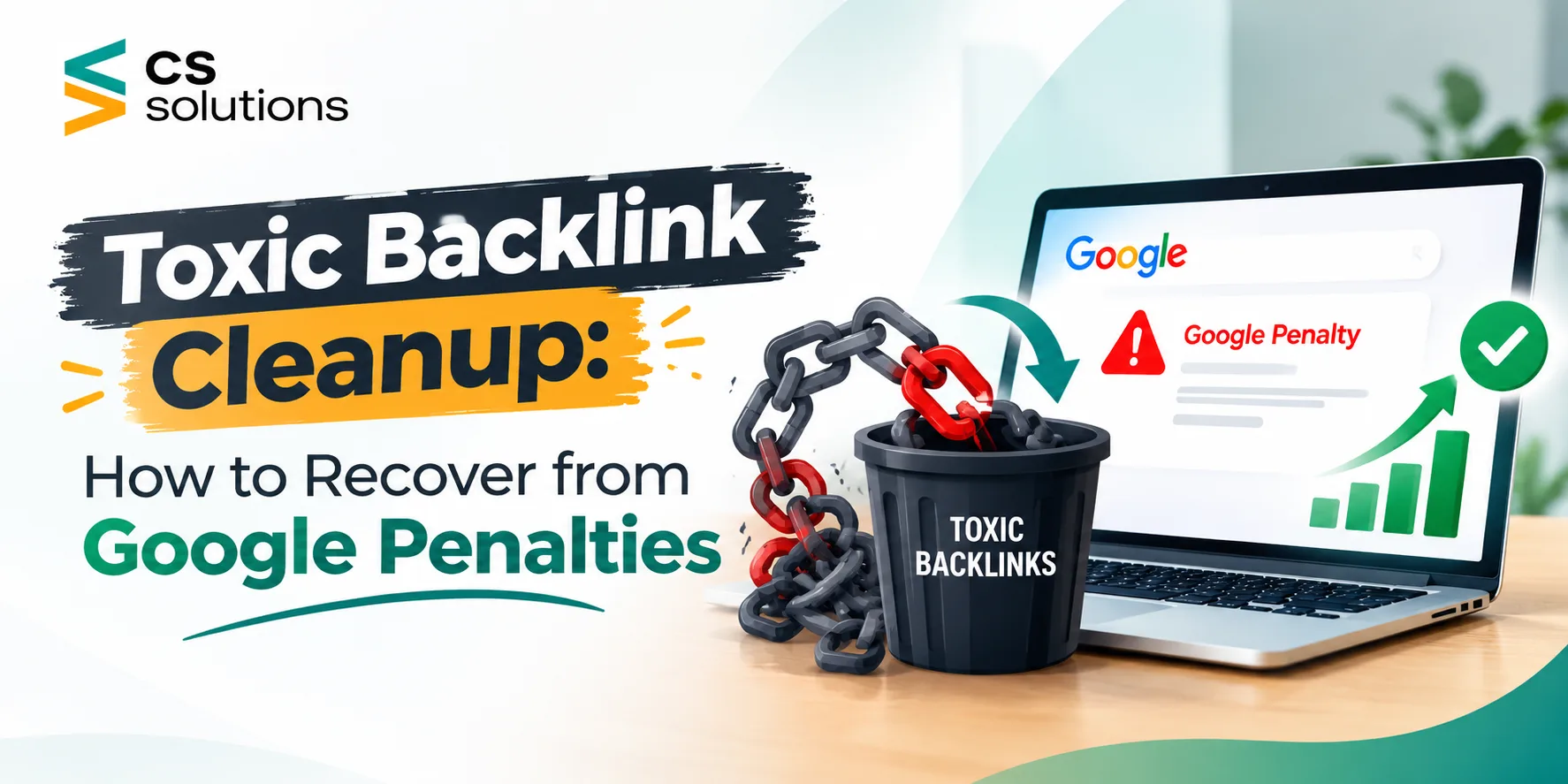
Suppose one morning you go to check your website and see that Google traffic and overall organic traffic is down. Toxic links, Google penalties, technical issues with Google crawling, or algorithm changes could hurt your organic traffic and search positions. The initial step to resolving the issue is defining the root cause.
In this article, we walk through how to detect Google penalties, go over various google penalties, examine your site, get rid of toxic links and poor-quality content, respond to Google’s manual actions, and monitor recovery and prevention. An experienced SEO company in Mississauga can assist you in overcoming challenges and recovering from Google penalties through ethical SEO practices.
What Are Toxic Backlinks?
It refers to the research process of toxic backlinks followed by their removal requests if possible and the use of Google’s Disavow tool in cases when unnatural backlinks profile has already appeared in the SERP. It should not be abused for all the low-quality or unknown backlinks; it should be used in documented cases.
What Is a Google Penalty?
A Google penalty is a manual action against a site suspected for using Google’s search policies by a reviewer. Usually, the notification shows that either unnatural links, spam, cloaking, redirects, and others were discovered on a site, and those pages would be demoted in the search results until Google gets an acceptable explanation.
How Many Different Penalties Does Google Have/Types of Google Penalties
- Manual Actions: These are issued when Google’s human reviewers find that a site is against their spam policies. The reasons can be unnatural outbound links, deceptive redirections, keyword stuffing, and having spammy or intrusive content. You can check for manual actions in Google Search Console.
- Algorithm Related Ranking Downtrends: These are caused by Google’s automatic systems reevaluating the position of a site on the search engine results pages. Spammy content, links, and other SEO factors related problems can cause them. They are usually the result of algorithm changes not penalties, which means that they rarely include a notification from Google.
Both issues may negatively affect the organic traffic and search visibility of the site. However, the accurate diagnosis of the problem and the use of an appropriate recovery technique can help the business fix the issue and improve the site’s SEO capabilities.
Step by Step Google Penalty Recovery Process
The recovery process should begin with diagnosis. Don’t delete the reports. Instead, try to retain reports, identify the affected pages and compare the dates in Search Console with the real dates when Google rolled out the algorithm updates. The following phases will assist startups, midsized businesses, and enterprise companies to devise an approach that will be repeated and followed.
Perform a Full Site Audit
Begin by analyzing your site to find potential SEO issues which may hurt your rankings, traffic, and performance. To get an idea of the problems, use various SEO tools:
- Ahrefs or Semrush: to check backlinks and toxic links;
- Screaming Frog: to find broken links, crawlers’ errors, redirect problems, and technical issues;
- Copyscape: to discover duplicated content on your site and elsewhere on the web;
- Google PageSpeed Insights: to measure the speed of your pages and see what can make them faster.
Once you’ve completed the SEO audit, fix the technical problems first, optimize the content which looks poor, delete insignificant pages, and take care of Google spam guidelines.
Remove or Disavow Toxic Backlinks
Do not consider all low DA backlinks as bad. Instead, look out for significant manipulative patterns, such as commercial anchors, sitewide placements, irrelevant foreign websites, or obvious automated creation. Double-check each suspicious link in Ahrefs, Semrush, and Search Console.
Create a request to take down the toxic links and send it to the targeted site’s administration. Make sure to note the page’s address, the date of your message, and whether the link was removed.
Improve Your Content
Thin pages, duplicated text, keyword stuffing, and vague service description are some of the factors that can deteriorate the quality of a site, regardless of the number of quality backlinks pointing to it. The professionals suggest reading the pages as an average customer would to determine if the page answers the main questions, demonstrates the expertise of the company and tells the visitors what to do next, apart from searching for more information.
The text should be edited to eliminate all similar sections, as well as to replace duplicated sentences with unique ones. Following that, it is essential to ensure that each page has appropriate headings, internal links, and addresses all the relevant issues, questions, and topics. In addition, the strong SEO content strategy should also be evaluated for compliance with the general requirements for quality content, as well as authoritativeness, contact availability, service-related descriptions, and customer-centric focus.
Submit a Reconsideration Request If Applicable
Use Google Search Console to submit a reconsideration request only after addressing a manual action. Explain the cause in plain language, describe the corrective work, provide evidence of link removal or content revision, and confirm that the site now follows Google’s spam policies. Don’t blame competitors or offer a vague promise that things have improved.
Google’s review timeline varies. Monitor the manual action report and keep improving the site while you wait. A reconsideration request doesn’t apply to an ordinary algorithm related ranking drop. In that situation, focus on diagnosis, quality improvements, technical corrections, and ongoing observation.
Stay Updated with Google’s Changes
Changes in search guidelines can be disruptive. To minimize this risk, ensure you remain up-to-date with the latest developments by following Google Search Central, Search Engine Journal and Moz.
Conduct an SEO audit on a regular basis and compare results page by page, device, query and country. If a drop is detected, investigate if there are any server issues, new deployment, redirects, robots.txt problems or any changes to the content before jumping to the conclusion that it is a penalty. This allows for more considered response and avoids panic-inducing link removals in the rush to respond.
Build Your Website for Long Term Trust
Long term credibility comes from ethical promotion and a useful visitor experience. Avoid purchased backlinks, private blog networks, hidden text, doorway pages, and manipulative anchor text. Keep templates fast, mobile friendly, accessible, and easy to navigate. Make business details accurate and keep important policies easy to find.
Publish helpful material based on genuine knowledge, then connect related pages with sensible internal links. A clear site structure helps visitors and crawlers understand how information is organized. Consistency, transparency, and compliance with Google’s spam policies offer stronger protection than short term ranking tactics.
How to Know You Have Recovered
Once you’ve addressed the issues affecting your website, improvements may become visible over several weeks or months. The recovery period depends on the nature of the problem, the fixes implemented, and how Google reassesses your site.
Look for these signs of progress:
- Organic Traffic Growth: Website visits from search engines begin to increase gradually.
- Improved Search Visibility: Your important pages start appearing more consistently in Google search results.
- Better Keyword Rankings: Target keywords show positive movement in search positions.
- Manual Action Revocation: Google Search Console confirms when a manual action has been lifted.
- Stronger Website Performance: Regular monitoring reveals improvements in impressions, clicks, and overall organic search engagement.
How Can You Prevent Future Google Penalties?
Once you fix the problems with your website Google will begin to recover. How long it takes to recover will be based on the issues you had and what action was taken to correct them. You may need to wait a few weeks or even a few months before any changes can be seen.
Here are some indicators that Google may be recovering:
- Organic traffic to your website will begin to rise
- Google is beginning to index your web pages more consistently
- Improvements in keyword rankings
- Google will notify you when they have removed a manual action
- Your website is getting more impressions and clicks from Google search.
- Overall improvements in organic traffic can take some time to appear so it is best to monitor these factors on a regular basis.
Conclusion
Experiencing a Google penalty or a drop in rankings may be disheartening, but the situation is not as bad as it seems since almost every issue can be resolved with the right approach. Multiple website audit services, backlink detoxification, high-quality content creation, and SEO auditing are just some of the solutions that will resolve the current issues and help you succeed in the long run.
CS Web Solutions is an SEO company that helps start-ups, midsized businesses, and enterprises overcome various SEO challenges and achieve their goals. Working in the SEO industry for more than ten years, the team has managed to help over 1000+ satisfied customers and is ready to provide enterprise-level support to your business. Thus, if you are looking for an expert SEO agency in Mississauga to resolve your issues and grow higher in the SERPs, you will get high-quality services after years of hard work and dedication.
Ready to recover your rankings and prevent future Google penalties? Call us at 905-890-2222 or email info@cswebsolutions.ca to strengthen your website’s SEO and protect your long-term search visibility.
Frequently Asked Questions
How long does it take to recover from a Google penalty?
Recovery can take several weeks to months, depending on the issue, corrective actions, and Google’s reassessment.
Will disavowing bad backlinks really help my site recover?
Disavowing links may help address serious unnatural-link issues, but it is not necessary for every low-quality backlink and does not guarantee recovery.
What’s the difference between a penalty and a regular ranking drop?
A manual penalty appears in Google Search Console, while a regular ranking drop may result from algorithm changes, competition, or technical SEO issues.
How can I make sure this never happens again?
Follow Google’s spam policies, avoid manipulative link-building, publish helpful content, and monitor your website’s SEO health regularly.
How can an SEO company help recover website rankings?
An experienced SEO company can audit your website, investigate ranking declines, identify backlink risks, resolve technical issues, and develop a recovery strategy aligned with Google’s guidelines.
Why Choose CS Web Solutions for Google Penalty Recovery?
CS Web Solutions offers ethical SEO strategies, toxic backlink audits, and technical optimization. With 10+ years of experience and 1,000+ happy clients, we help businesses improve search visibility and support long-term SEO growth. Contact us.