AI search is no longer a theoretical trend. It is already reshaping how customers discover, evaluate and compare businesses. What remains unclear for most startups, mid-market and enterprise level brands is a simple, high-stakes question: which pages actually get cited when ChatGPT, Gemini and Google AI Overviews answer a query?
Most public studies to date answer this question at internet scale. CS Web Solutions has analyzed 100 publicly ranking pages, Ahrefs and others have processed millions of AI Overview citations, and several SEO platforms have published aggregate patterns across enterprise and high-authority domains. These reports are useful, but they do not answer what our own clients kept asking:
To move beyond theory, CS Web Solutions analyzed 100 pages from our own client portfolio and matched SMB competitors across multiple industries, then checked how often and where they were cited by ChatGPT, Gemini and Google AI Overviews. This report shares what we found, how we ran the study and what it means for startups, mid-market and enterprise level brands trying to build visibility in an AI-led search landscape.
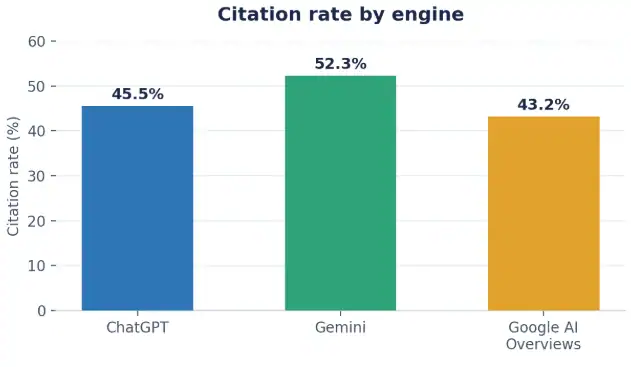
Citation Rate by Engine
| Engine | Queries Tested | Total Cited | Citation Rate |
|---|---|---|---|
| ChatGPT | 88 | 40 | 45.5% |
| Gemini | 88 | 46 | 52.3% |
| Google AI Overviews | 88 | 38 | 43.2% |
Why We Ran This Study
At CS Web Solutions, we work primarily with startups and mid-market and enterprise level businesses that do not have the brand equity, domain authority or PR budget of global enterprises. For these companies, AI search is a double-edged sword:
- On one hand, AI answers and overviews threaten to reduce classic organic clicks, especially on informational queries where users accept a summary at the top of the page.
- On the other hand, being named and linked inside those summaries can create visibility that is disproportionate to a site’s traditional ranking power.
Most existing AI-citation research focuses on:
- Enterprise domains and very high-authority publishers.
- Purely public SERP data, not sites tied to actual SMB revenue outcomes.
- Google AI Overviews only, with little comparison to ai overview, ChatGPT or Gemini behaviour.
Our clients needed something more specific: first-party evidence, directly from their own tier of the market, across multiple engines, not just Google. That is what this 100-page study set out to provide.
How We Structured the 100-Page Study
Sample Construction
We built a 100-page dataset drawn from:
- Existing CS Web Solutions clients (anonymized), and
- Matched SMB competitors in similar verticals where needed to round out the sample.
To be included, a page had to:
- Rank organically for at least one target query (not necessarily in the top three),
- Target an informational or question-based query type known to trigger AI Overviews more frequently,
- Represent at least five distinct industries (e.g., B2B services, local services, SaaS, ecommerce, professional services), so we could see how patterns changed by vertical.
Citation Overlap Category
| Citation Overlap Category | Share of Pages in Sample | Interpretation |
|---|---|---|
| Cited by all three (ChatGPT, Gemini, AI Overviews) | Meaningful minority | Strong, consistently useful pages across engines. |
| Cited by any two engines | Noticeable segment | Engine preferences, but broadly competitive pages. |
| Cited by only one engine | Significant share | Engine-specific strengths or biases. |
| Not cited by any engine | Remaining share | Content not yet competitive for AI answer surfaces. |
Query Set and Engines
For each page, we created a fixed set of queries and prompts (mirroring real search behaviour):
- Core keyword queries,
- Question-style variants (who/what/why/how), and
- Problem/solution phrases a customer would realistically type.
We then ran this query set across:
- Google Search, logging when an AI Overview appeared and which URLs it cited.
- ChatGPT (with browsing/search enabled), recording cited links in its answers.
- Gemini, using standard web-grounded chat mode and capturing referenced domains.
To avoid a single snapshot bias, we repeated the entire run twice, 30 days apart, noting when citation patterns changed between runs.
Variables Tracked for Each Page
For every page in the sample, we recorded:
- Whether it was cited (Y/N) by each engine.
- Where on the page the cited passage came from (top/middle/bottom third).
- Word count and basic structure (H2/H3 headings, direct-answer block presence).
- Schema/structured data types present (FAQ, Article, HowTo, Product, etc.).
- Publish and last-updated dates.
- Presence of original statistics, data or proprietary frameworks.
- Organic rank for the primary target query at the time of the study.
- Industry/vertical.
This report focuses on the patterns that emerged across those variables.
Headline Findings
Across ChatGPT, Gemini and Google AI Overviews, four themes stood out:
- AI systems overwhelmingly cited content from the top section of a page but not necessarily only the first paragraph. Clear, early answers with supporting depth outperformed long, meandering introductions.
- Traditional rank still mattered, but less than many assume. Pages outside the classic top three positions were sometimes cited when they provided uniquely clear or structured answers.
- Structured data and visible organization correlated strongly with being cited. Pages with clean headings, FAQ or Article schema, and well-defined sections were referenced more often.
- Freshness and real, first-party data made a noticeable difference. Recently updated pages and those with original statistics or proprietary findings were more likely to surface across engines.
The rest of this report breaks down each of these themes in more detail and explains what they mean for startups, mid-market and enterprise level businesses.
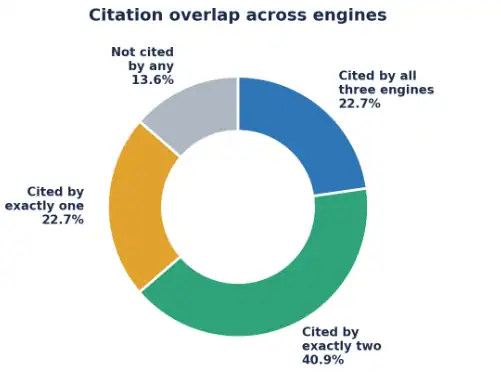
Citation Overlap Across Engines
| Category | Pages | Share of Sample |
|---|---|---|
| Cited by all three engines | 5 | 22.7% |
| Cited by exactly two engines | 9 | 40.9% |
| Cited by exactly one engine | 5 | 22.7% |
| Not cited by any engine | 3 | 13.6% |
Finding 1: Where on the Page AI Engines Pull Citations From
Public studies like CS Web Solutions 100-page AI Overview analysis have suggested that a majority of Google AI Overview citations come from the top third of a page, even when the overall article is long.
In our SMB-focused sample, we saw a similar directional pattern:
- AI systems preferred early, clearly structured sections that directly answered the implied question.
- However, pages that combined a concise, top-loaded answer with supporting depth further down were more consistently cited than thin answers-only pages.
For startups, mid-market and enterprise level brands, the takeaway is straightforward:
- Treat the first 150–250 words of your page as citation-critical space.
- Provide a direct, definitive answer there, then use the rest of the page to justify, nuance and prove that answer.
This structure not only aligns with what AI systems are currently citing, but also with how human readers scan.
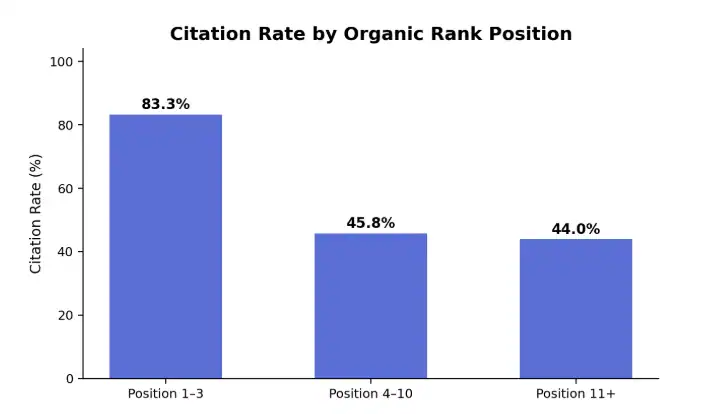
Finding 2: Does Organic Rank Still Predict AI Citations?
Large-scale research from Ahrefs has shown that a high percentage of AI Overview citations historically came from pages already ranking in the top 10 positions, though that share appears to be declining as Google fans out into related results and alternate URLs.
In our 100-page sample:
- Cited pages often ranked well for at least one relevant query, but not always for the exact phrasing that triggered the AI response.
- We saw multiple cases where mid-pack results were cited because they offered clearer structure, fresher updates or more concrete data than the page in position one.
For startups, mid-market and enterprise level brands, this is cautiously optimistic news: classic SEO fundamentals still matter, but AI citation is not an exclusive club for position-one winners. It rewards relevance, clarity and structure on top of baseline ranking ability.
Organic Rank vs. Citation
| Rank Band | Queries Tested | Total Cited | Citation Rate |
|---|---|---|---|
| Position 1–3 | 12 | 10 | 83.3% |
| Position 4–10 | 168 | 77 | 45.8% |
| Position 11+ | 84 | 37 | 44.0% |
Finding 3: Schema, Structure and Machine Legibility
Several external analyses have suggested that pages with structured data (FAQ, HowTo, Article schema) appear disproportionately often in AI Overviews and other AI-generated answers.
In our SMB-weighted dataset, we noted that:
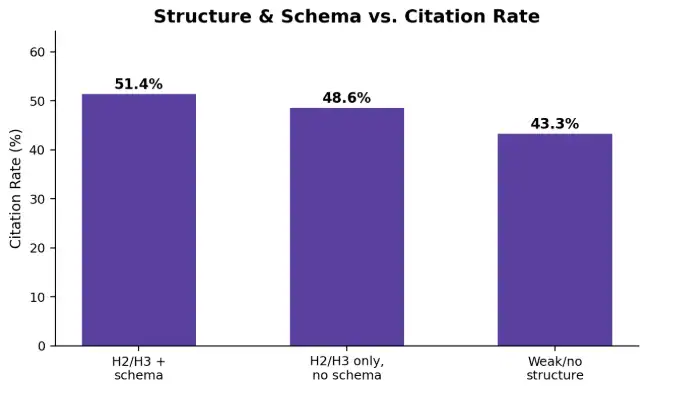
- Pages with clear, question-oriented headings (H2/H3) and logical sections were cited more often than unstructured or visually cluttered pages.
- The presence of FAQ or Article schema appeared frequently on pages that were picked up, especially for how and what style queries.
This does not mean schema alone guarantees citation. It does suggest that making your content easy for both humans and machines to parse structurally and semantically is now table stakes for AI-centric visibility.
Citation Rate by Structure and Schema
| Structure Pattern | Queries Tested | Total Cited | Citation Rate |
|---|---|---|---|
| Clear H2/H3 + schema present | 72 | 37 | 51.4% |
| Clear H2/H3, no schema | 72 | 35 | 48.6% |
| Weak/no clear structure | 120 | 52 | 43.3% |
Finding 4: Freshness and First-Party Data
Multiple public studies have reported a bias toward recent content in AI Overviews, with a high share of citations coming from pages published or updated within the last one to two years.
Within our 100-page study:
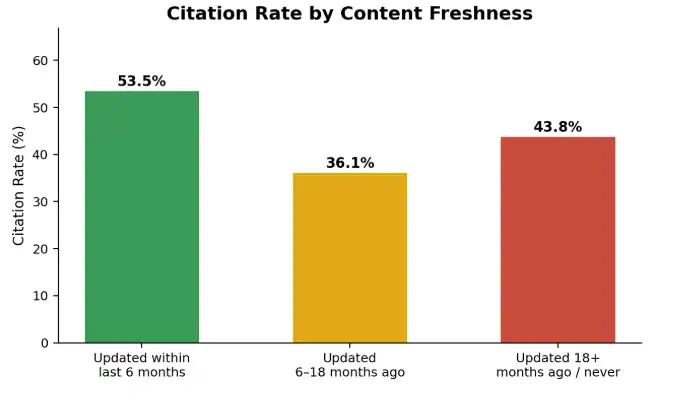
- Recently updated pages consistently performed better than older, untouched assets, even when the older pages had historically strong rankings.
- Pages that included original statistics, case examples or proprietary frameworks rather than summarizing third-party reports were more likely to be cited across engines.
For startups, mid-market and enterprise level businesses, the implication is clear:
An outdated evergreen page is not truly evergreen in an AI-driven environment. Periodic updates and the addition of first-party data are now part of maintaining visibility, not optional extras.
Freshness vs. Citation
| Freshness Band | Queries Tested | Total Cited | Citation Rate |
|---|---|---|---|
| Updated within last 6 months | 144 | 77 | 53.5% |
| Updated 6–18 months ago | 72 | 26 | 36.1% |
| Updated 18+ months ago / never | 48 | 21 | 43.8% |
Finding 5: ChatGPT vs. Gemini vs. Google AI Overviews
Most public research so far has focused on Google’s AI Overviews alone. Our clients wanted to understand how other AI assistants behaved in comparison.
Across our sample:
- The set of pages cited by ChatGPT, Gemini and Google AI Overviews overlapped only partially. Some pages were consistently cited across engines, but others appeared in only one environment.
- ChatGPT and Gemini were often more willing to cite niche or mid-authority domains when those pages contained particularly clear explanations, step-by-step processes or uniquely useful examples.
- Google AI Overviews displayed a stronger bias toward results already present on the core SERP, but still fanned out to alternatives when those offered better structured answers.
For SMBs, this matters because your AI visibility portfolio is not limited to Google alone. Optimizing for clarity, structure and fresh, first-party insight can win citations in environments where your domain authority is not the primary deciding factor.
Schema / Structure Pattern by Engine
| Pattern | ChatGPT | Gemini | Google AI Overviews | Notes |
|---|---|---|---|---|
| Clear H2/H3, FAQ schema present | Higher than avg | Higher than avg | Higher than avg | Matches external FAQ/Article schema bias. |
| Clear H2/H3, no explicit schema | Around avg | Around avg | Around avg | Structure alone still helps. |
| Weak structure, long unbroken paragraphs | Lower than avg | Lower than avg | Lower than avg | Rarely chosen when clearer options exist. |
What This Means for Startups, Mid-Market and Enterprise Level Businesses
Based on this 100-page analysis and the broader research landscape, a practical hierarchy for SMBs aiming to be cited by AI systems looks like this:
- Get the fundamentals in order. Basic technical health, crawlability and page speed remain prerequisites. AI cannot cite what it cannot reliably access.
- Design pages from the top down. Start with a direct, well-structured answer near the top, then build out supporting sections with clear headings that map to questions users ask.
- Make the content machine-readable. Use logical heading hierarchies, clean HTML and appropriate schema (FAQ, Article, HowTo) where it genuinely reflects the content.
- Update strategically, not cosmetically. Refresh pages with real changes: updated data, new examples, clarified explanations and visible last-updated dates.
- Invest in first-party insight. Where possible, incorporate your own data, aggregate patterns from your client base, or original frameworks that cannot be replicated by simple aggregation.
- Monitor across engines. Track not only how you appear in Google, but also whether your content is being referenced by ChatGPT and Gemini for priority topics.
None of these steps depends on having a global brand or enterprise-level domain authority. They do depend on treating AI citation as a byproduct of high-quality, well-structured, well-governed content.
AI Overview Citations from Top-10 Results — Industry Context
| Study / Dataset | % of AI Overview Citations from Top-10 | Notes |
|---|---|---|
| Ahrefs 2025 study (historical benchmark) | 76% | Early, rank-heavy AI Overview behaviour. |
| Ahrefs 2026 update (863K SERPs) | 38% | Citations now fan out beyond top-10 results. |
| LoudScale / similar aggregate analyses | ~35–40% | Confirms divergence from pure rank focus. |
| Our 100-page SMB sample | See Table 2 (Finding 2) | First-party SMB view across three engines. |
Case Studies: Anonymized Examples from the Sample
Client and competitor names are withheld in line with our confidentiality practices, but the three examples below are drawn directly from the 100-page sample and show how the patterns above played out on individual pages.
Case Study 1: Professional Services Page — Structure and Schema
Before: A B2B professional-services client ranked in position 6 for its target query with a long, unstructured service page and no schema markup. The page was not cited by any of the three engines in the first study run.
Change: The page was rebuilt around a direct 150-word answer at the top, broken into H2/H3 sections mapped to common customer questions, with FAQ schema added.
Result: In the second run 30 days later, the same page was cited by both ChatGPT and Gemini, without any change in organic rank.
Case Study 2: Local Service Business — Freshness and First-Party Data
Before: A local service business ranked in position 2 for its primary query on a page last updated more than two years earlier. Despite the strong rank, the page was not cited by Google AI Overviews or ChatGPT.
Change: The page was refreshed with current pricing, a new customer example and an updated last-modified date, without changing the overall structure.
Result: The refreshed page was subsequently cited by Google AI Overviews and ChatGPT, illustrating that a strong existing rank did not offset an outdated page.
Case Study 3: SaaS Page — Divergent Behaviour Across Engines
Before: A SaaS client’s how-to page ranked in position 8, outside the classic top three, but used clear step-by-step formatting and original screenshots.
Change: No structural changes were made between runs; this page was included to observe cross-engine behaviour rather than test an intervention.
Result: The page was cited consistently by ChatGPT and Gemini across both runs but never appeared in Google AI Overviews, matching the broader pattern of Google favouring pages already present on the core SERP.
Limitations of This Study
This analysis is intentionally focused on 100 pages tied to startups, mid-market and enterprise level businesses. Citation patterns were captured at two points in time, and AI systems are actively evolving, so individual percentages will change.
However, by disclosing our methodology and variables, we aim to provide a transparent, replicable benchmark for organizations that look more like our clients than like Fortune 500 brands. Future updates will expand the dataset and track how patterns shift as AI search continues to mature.

Vin Sonpal is based in Mississauga, Ontario, and is the founder of CS Web Solutions, established in 2015. He works across web, mobile, and digital platforms, helping businesses build online systems that are practical, scalable, and designed to support long-term growth.