Something strange happened to search over the last two years. The old tricks stopped working. Stuffing a page with the same keyword used to move the needle. Now AI Overviews, ChatGPT, and Perplexity look at that and see noise, not relevance.
Here is what they actually want. Understanding. These Large Language Models (LLMs) read your website the way a sharp, well-read person would. They want to know who you are, what you genuinely do, and how you connect to everything else in your space.
That is entity-based SEO in a sentence. And for any business serious about AI SEO services in Toronto, it is the line between getting cited in an AI answer and disappearing from the conversation entirely.
What Is Entity-Based SEO?
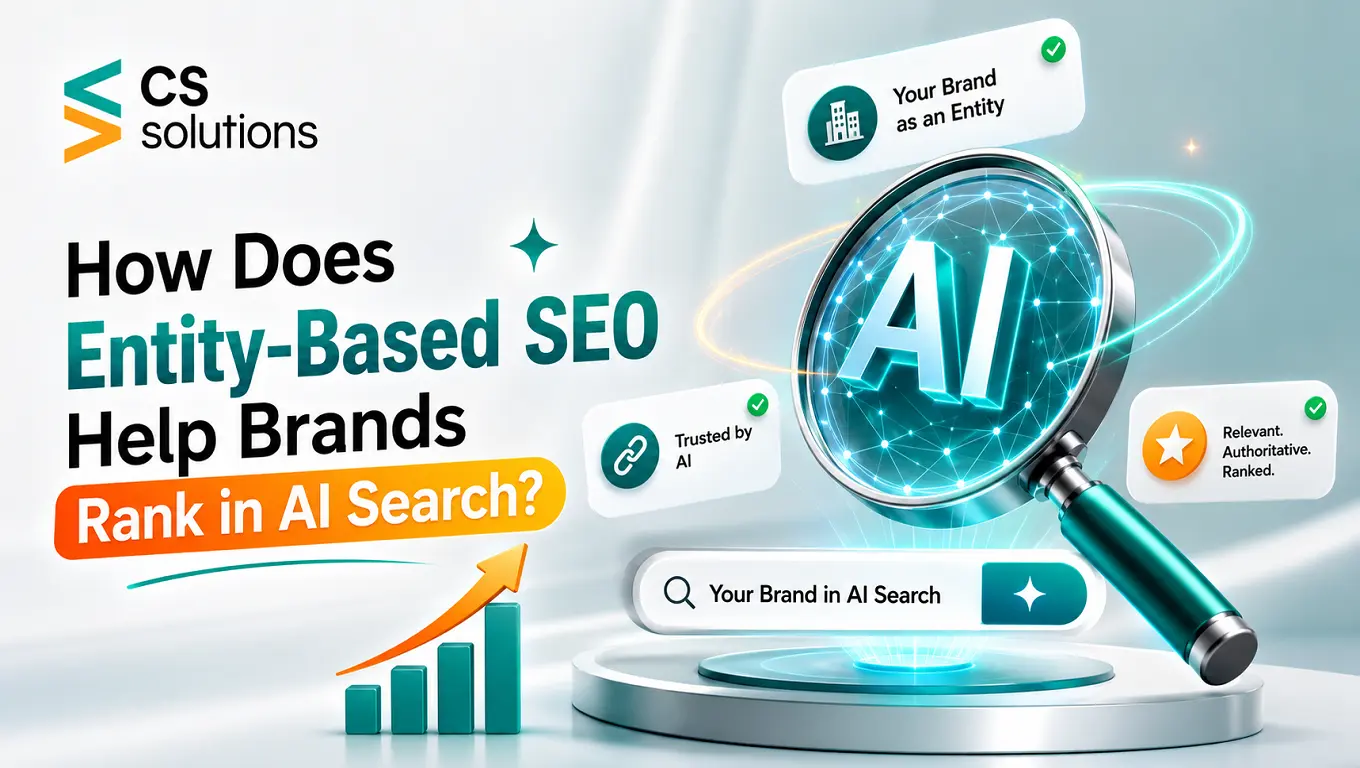
Entity-based SEO means optimizing your content around real, defined things. People, places, concepts, brands. Not scattered keywords. It helps search engines actually understand what you mean, which is the whole point of AI SEO optimization.
The Shift from Keywords to Entities
SEO used to be a matching game. You picked a phrase, repeated it just enough, and hoped Google rewarded you for it. Anyone who did SEO in 2015 remembers the drill. Those days are finished. Modern AI search models understand context now. They use knowledge graphs to recognize that a “Toronto dentist” and a “dental clinic in the GTA” are the same idea wearing different words.
Entity-based SEO works with that intelligence instead of trying to game it. A real AI-powered SEO audit today asks one question. Does the search engine understand what your brand actually is? Not how many times you said the magic phrase.
Why Is Entity-Based SEO Important for Modern Search Engines?
Search engines stopped counting and started comprehending. They can tell the difference between content that genuinely knows a subject and content that just mentions it on the way past.
This is exactly where AI-driven SEO earns its keep. Build your site around well-defined entities and search engines start treating you as a credible authority. And here is the part business owners love. That authority does not lift just one keyword. Semantic SEO lifts you across whole groups of related searches, because the engine has decided you genuinely own the topic rather than rent a piece of it.
The Strategic Benefits of Entity Optimization
The case for entity optimization is not complicated. It puts your brand where your customers are already looking, and it makes search engines trust you enough to recommend you.
When your content is built around clear entities, AI is far more likely to cite you in its answers. That is everything in a world of zero-click searches, where people read the answer right inside AI Overviews and never click a thing. Being the source they quote is the new first place.
Entity-focused content also strengthens your E-E-A-T signals, which stand for experience, expertise, authoritativeness, and trustworthiness. That is the exact checklist AI runs before deciding who to believe. For businesses leaning into AI SEO services in Brampton and across the GTA, this is how content quietly becomes citations and reputation becomes visibility you can actually measure.
How to Implement Entity-Based SEO
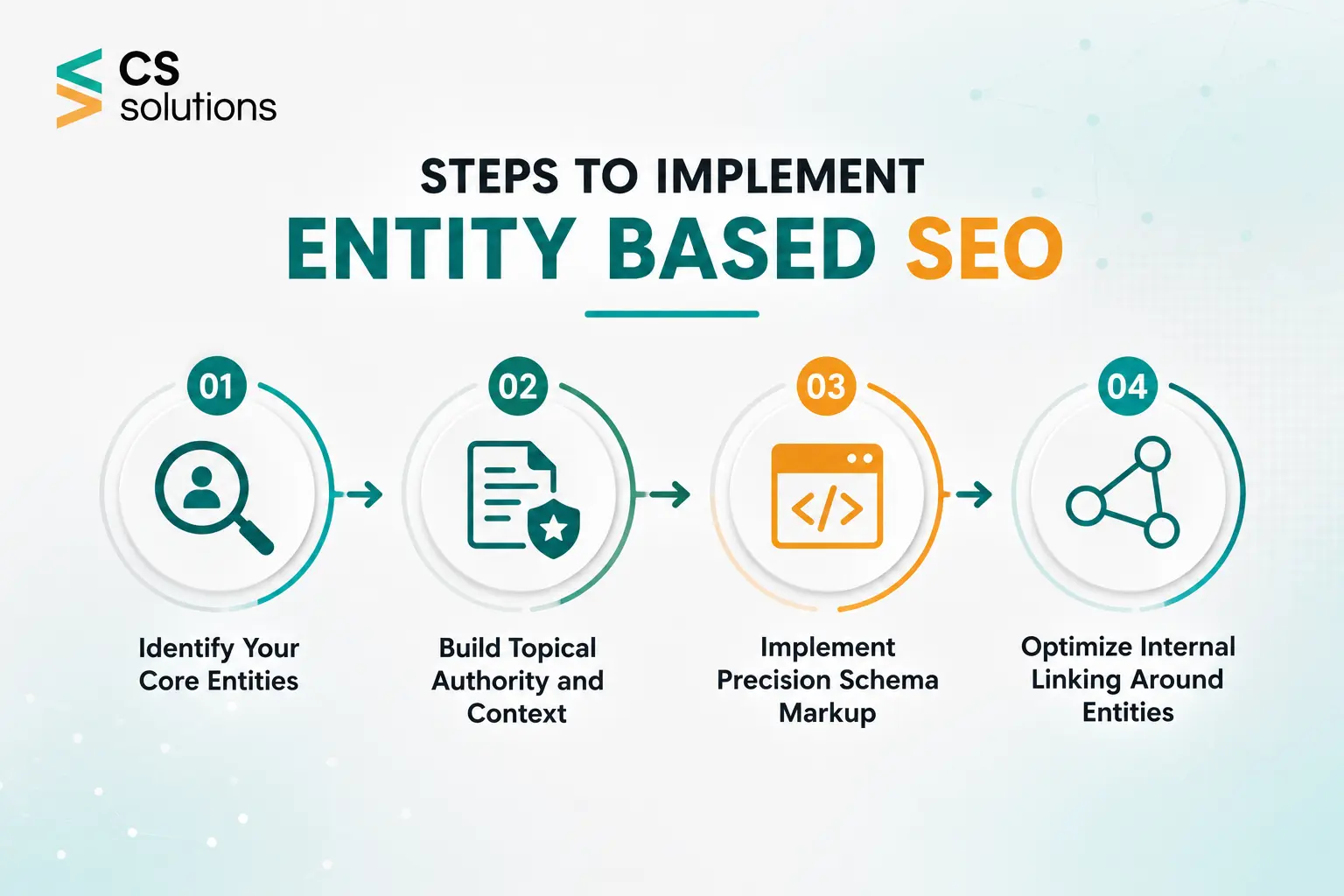
1. Define Your Core Entity Set and Create an Entity Map
Figure out your main entities, your core topics, and how they all connect. Mapping it out gives your site a structure that makes sense, supports linked entities SEO, improves SEO for AI Overviews, and sets up real LLM SEO.
2. Build Pillar Pages and Topic Clusters Around Entities
Write deep pillar pages on your core topics, then surround them with cluster pages on the related subtopics. That web of content strengthens your authority and reinforces content relationships SEO, showing your linked entities SEO actually runs deep.
3. Implement Rich Structured Data with Stable IDs
Use schema markup and JSON-LD with @id and sameAs properties so search engines know exactly who they are looking at. Good schema markup optimization and structured data SEO tie your brand to trusted sources and leave zero room for confusion.
4. Optimize Internal Linking Around Entities
Use clear, descriptive anchor text so search engines understand how your topics relate. Smart linking connects your entity-focused content and hands AI SEO systems a clean map of your whole site.
5. Align On-Page Content with Entity Context
Spell out your entities and the context around them right in the content. That clarity boosts AI content discoverability, so AI reads your pages correctly instead of guessing what you meant.
6. Connect to External Knowledge Graphs and Authoritative References
Link your entities to trusted directories, sources, and knowledge graphs. Those connections build credibility, and every serious AI SEO provider, whether an SEO company in Vancouver or anywhere else, knows it matters.
Common Implementation Mistakes to Avoid
Even smart teams trip here. The classic mistake is treating keywords like entities and optimizing for phrases instead of meaning. Others botch their schema and break the exact data AI depends on. And plenty of businesses water down their authority by piling unrelated topics onto one site, which wrecks semantic relevance and tanks AI search visibility. A focused site beats a scattered one every single time. Any honest SEO company in Mississauga will tell you the same.
Future-Proofing Your Visibility
AI search rewards knowledge, context, and genuine depth. The brands that win are the ones investing now in entity clarity, clean structured data, real topical coverage, and authoritative connections. Search is not going back to keyword matching. It is moving deeper into understanding, and the businesses doing the work today are the ones AI will quote tomorrow.
CS Web Solutions is a proudly Canadian, award-winning AI SEO company in Toronto helping businesses across Canada stay visible as search evolves. With 10+ years of experience, 500+ satisfied clients, and verified credentials including Google Partner and Semrush Certified Agency Partner, they build entity-based strategies designed for how search actually works in 2026. Visit cswebsolutions.ca and start the conversation.