
Schema markup appeared in virtually every client conversation this year, so we figured it was time to stop speculating and start quantifying. We conducted an audit of 500 websites from 15+ industries, and 68% were live with partially or fully missing structured data. It was mostly just organization schema, which is the most basic one with minimal effectiveness. Not as much as those pages warranted in LocalBusiness, Review, FAQ, Article, Author and Video markup.
We ran every site through Google Rich Results Test and the Schema.org Validator, then opened the JSON-LD by hand to figure it out because of how often the tools disagreed with each other (more than you might think). Why bother? Because our earlier 100-page AI citation analysis showed structured pages earning citations more consistently. This study answers the follow-up question: which schema types are businesses actually skipping?
About Our Research: Analyzing 500 Websites
We pulled sites from SaaS, healthcare, legal, ecommerce, manufacturing, educational, non-profits, events, booking websites, agency verticals, and many more. Some websites were basic, five-page service sites that didn’t have valuable content. Others were enterprise platforms with thousands of URLs and dedicated dev teams. About 70% sat in SMB territory and 30% qualified as enterprise, which mirrors the market we serve every day.
Each audit followed the same routine: crawl the key templates, validate whatever markup exists, then compare that against what the content type actually calls for. We scored presence, syntax, property completeness, and whether the schema matched the page it lived on.
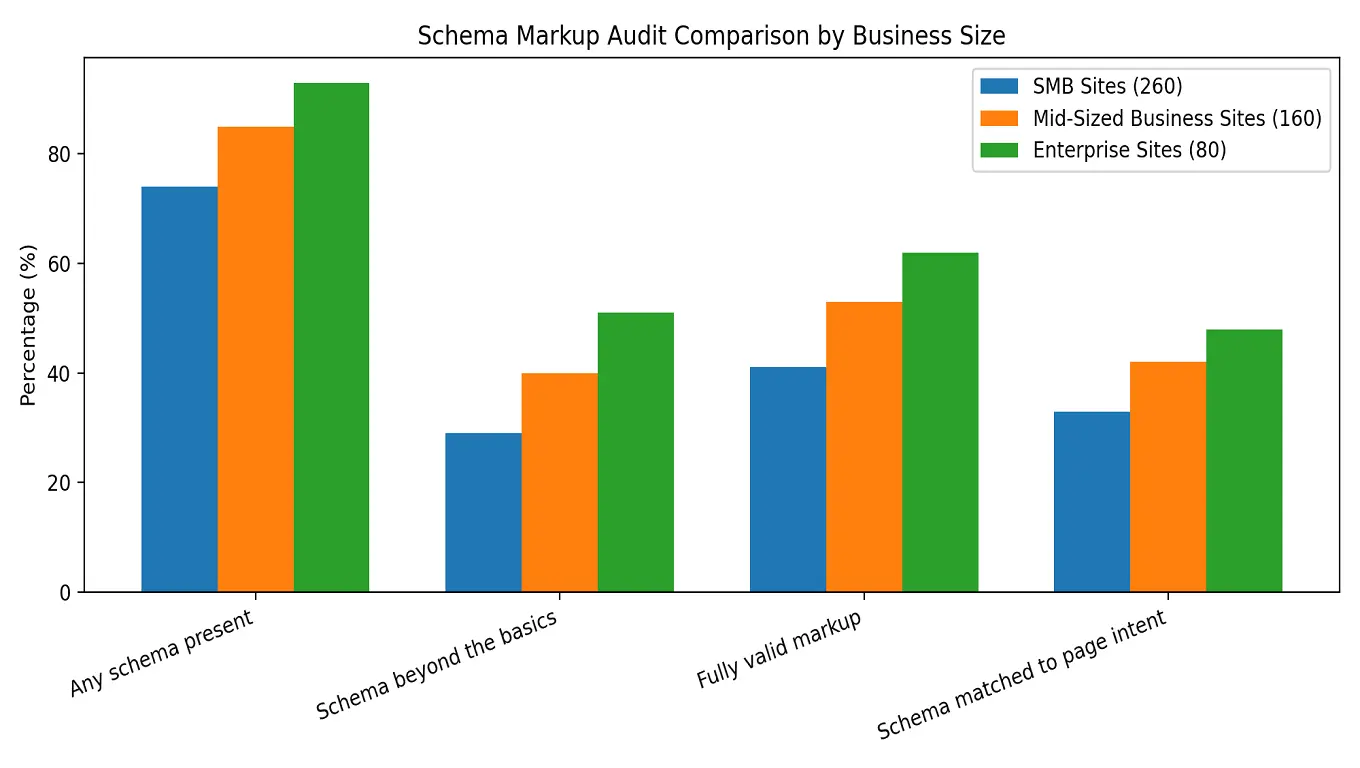
| Audit Dimension | SMB Sites (260) | Mid-Sized Business Sites (160) | Enterprise Sites (80) |
| Any schema present | 74% | 85% | 93% |
| Schema beyond the basics | 29% | 40% | 51% |
| Fully valid markup | 41% | 53% | 62% |
| Schema matched to page intent | 33% | 42% | 48% |
The Most Common Gaps We See in Schema
Seven patterns kept repeating across all 500 audits. We stopped being surprised somewhere around site number 200. Each gap below is a door your competitors are leaving open right now.
Finding #1: Most Websites Only Use Basic Schema
Some 62% of sites carried Organization, WebSite, and Breadcrumb schema and stopped there. In most cases, an SEO plugin generated all three automatically, and everyone assumed the job was done. Those types tell a machine who you are and how your site is arranged. They say almost nothing about what any individual page offers, and that second part is where citations come from.
| Schema Depth | Share of Sites |
| Basics only (Organization, WebSite, Breadcrumb) | 62% |
| Basics + 1–2 content schemas | 27% |
| Rich, page-specific schema stack | 11% |
Finding #2: FAQ Schema Is Underutilized
Almost half of the sites we audited had absolutely magnificent FAQ sections just sitting on the page, easily visible for anyone to see, but only 22% put these into proper FAQPage markup. Those questions are nearly a verbatim match for customer intent and thus, present the perfect raw material for ChatGPT answers or Google AI Overviews. The markup takes twenty minutes.
| FAQ Status | Share of Sites |
| FAQs present + schema applied | 22% |
| FAQs present, schema missing | 47% |
| FAQ content absent entirely | 31% |
Finding #3: Author & Person Schema Are Missing
Blogs were the biggest problems here. A full 81% published content with zero Author or Person markup, meaning the expertise behind the article stays invisible to machines. E-E-A-T runs on exactly this data: names, credentials, and sameAs links pointing to LinkedIn or professional profiles. An article written by an actual expert deserves to say so in a format Google can verify.
| Author Markup Status | Share of Blogs |
| Person schema with sameAs links | 8% |
| Author name only, minimal properties | 11% |
| Zero author markup | 81% |
Finding #4: Product & Service Pages Lack Structured Data
Commercial pages carry the revenue, yet 66% skipped Product and Service schema, and 84% left out Offer and Review markup. Every one of those omissions costs something visible: price displays in ai search results, star ratings, eligibility for shopping surfaces. We regularly found sites with hundreds of genuine reviews sitting in a widget that machines are unable to read.
| Commercial Page Markup | Share of Pages |
| Product/Service schema present | 34% |
| Offers included | 19% |
| Review/AggregateRating included | 16% |
Finding #5: Local Businesses Ignore LocalBusiness Schema
Of the local businesses in our sample, 58% lacked LocalBusiness schema entirely. Among those who had it, the details thinned out fast. Geo coordinates appeared on 14% of sites. The areaServed property, which tells engines exactly which towns you cover, showed up on 9%. Map packs, voice search, and “near me” AI answers all feed on these fields.
| LocalBusiness Property | Adoption Rate |
| Full address (PostalAddress) | 39% |
| Opening hours | 24% |
| Geo coordinates | 14% |
| areaServed | 9% |
Finding #6: Missing AI-Friendly Schema Types
Under 6% of sites touched the newer, AI-relevant types, and this is where the real headroom lives. HowTo structures step-by-step guides. VideoObject and ImageObject describe media so engines can surface it. Speakable flags voice-ready passages, ClaimReview backs up factual statements, Dataset exposes original research like the study you are reading, and Software Application defines exactly what a SaaS product does.
| AI-Friendly Schema Type | Adoption Rate |
| HowTo | 5.4% |
| VideoObject | 4.8% |
| SoftwareApplication | 3.2% |
| Speakable / ClaimReview / Dataset | Under 1% each |
Finding #7: The Biggest Schema Mistakes We Found
Having schema and having working schema turned out to be very different things. Our validators caught invalid JSON-LD, duplicate blocks injected by two plugins fighting over the same page, missing required properties, nesting errors, Product schema sitting on blog posts, deprecated types from 2019, and a near-universal absence of any testing routine. Broken markup sends confused signals, and confused signals get ignored.
| Implementation Error | Share of Sites Affected |
| Missing required properties | 44% |
| Duplicate schema blocks | 31% |
| Invalid JSON-LD syntax | 23% |
| Incorrect nesting | 19% |
| Schema on the wrong page types | 17% |
Industry-Wise Schema Adoption Trends
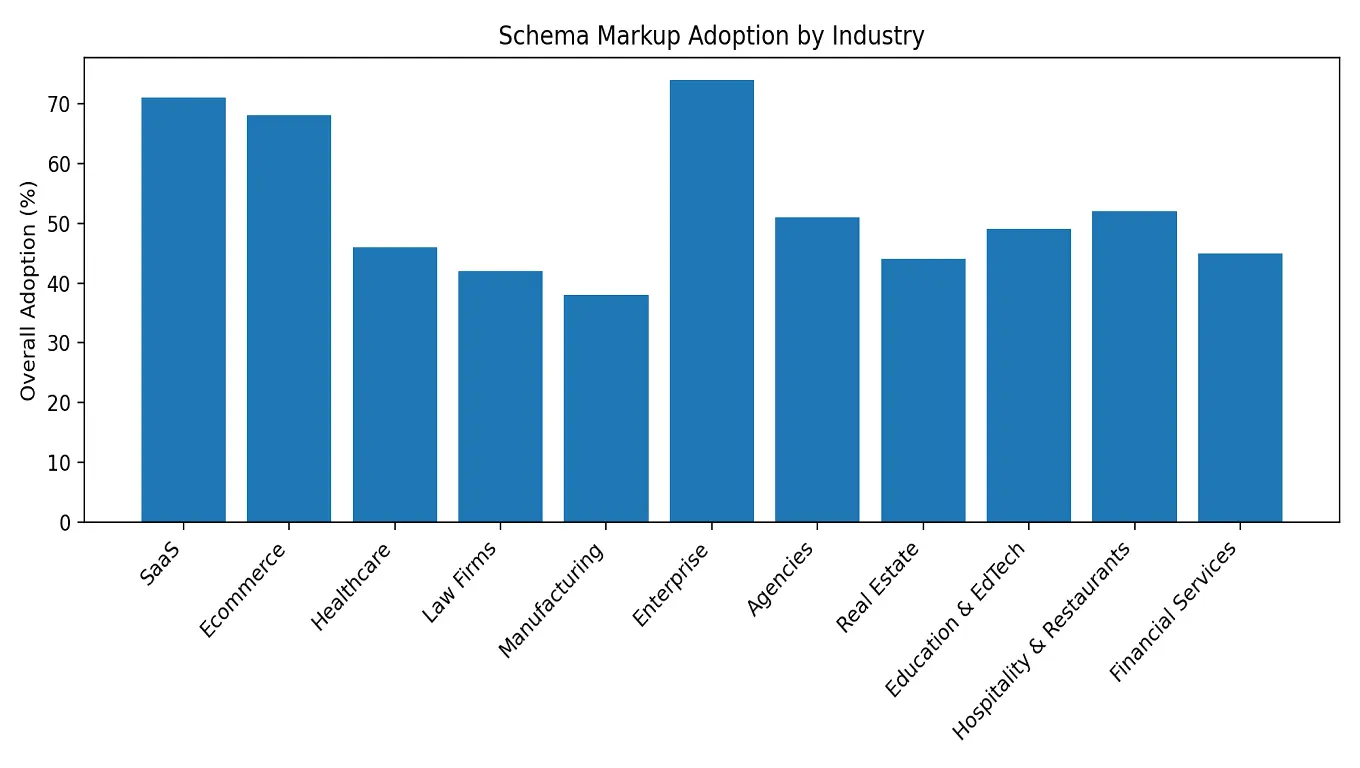
The vertical patterns told their own story. SaaS and ecommerce led on breadth because their platforms push markup by default. Healthcare and law firms trailed badly on author and expertise markup despite being the industries where credibility matters most. And agencies, our own corner of the world, showed the widest gap between what they sell and what their own websites practice.
| Industry | Overall Adoption | Strongest Area | Biggest Gap |
| SaaS | 71% | Article, Organization | SoftwareApplication |
| Ecommerce | 68% | Product | Review, Offers |
| Healthcare | 46% | Organization | Author/Person, MedicalWebPage |
| Law Firms | 42% | LocalBusiness | FAQ, Attorney/Person |
| Manufacturing | 38% | Organization | Product, Service |
| Enterprise (mixed) | 74% | Breadcrumb, Article | FAQ, HowTo |
| Agencies | 51% | WebSite | Nearly everything else |
| Real Estate | 44% | LocalBusiness | Product (listings), ImageObject |
| Education & EdTech | 49% | Organization, Article | Course, FAQ |
| Hospitality & Restaurants | 52% | LocalBusiness | Menu, Review, Event |
| Financial Services | 45% | Organization | Author/Person, FAQ |
Conclusion
Five hundred audits later, our takeaway is simple: most websites are competing with a fraction of the markup their content has already earned. The writing exists. The reviews exist. The expertise exists. The machine-readable layer that turns all of it into visibility is what keeps going missing, and that gap is precisely the opportunity, because your competitors are sitting in the same 68%.
CS Web Solutions offers a free schema audit that compares your current markup with your website content, identifies broken or missing structured data, and prioritizes the schema types that can deliver the greatest SEO impact for your industry. To request your free schema audit, email us at [email protected] or call us at 905-890-2222. Let your website communicate clearly with Google, AI search engines, and every platform that relies on structured data.