

Everyone has a theory about local ranking factors. We got tired of theories, so CS Web Solutions pulled the data ourselves: 100 cities, over 1,000 Google Business Profiles, each one scored by hand with the checklist we’ve beaten into shape over ten years of helping startups, mid-sized companies, and enterprise organizations crack the map pack.
Stare at a thousand profiles long enough and you will start seeing a pattern. Winners look the same in every city. So do losers. Google Business Profile data, Google Search Console, Semrush, and Ahrefs did the heavy lifting, and a human checked every number before it made this page.
Top Local Ranking Factors We Observed
Ten factors decided who showed up. Their pecking order humbled us a little, because profiles and reviews crushed everything else, while the deliverables agencies love putting on invoices, like social signals, barely registered a pulse.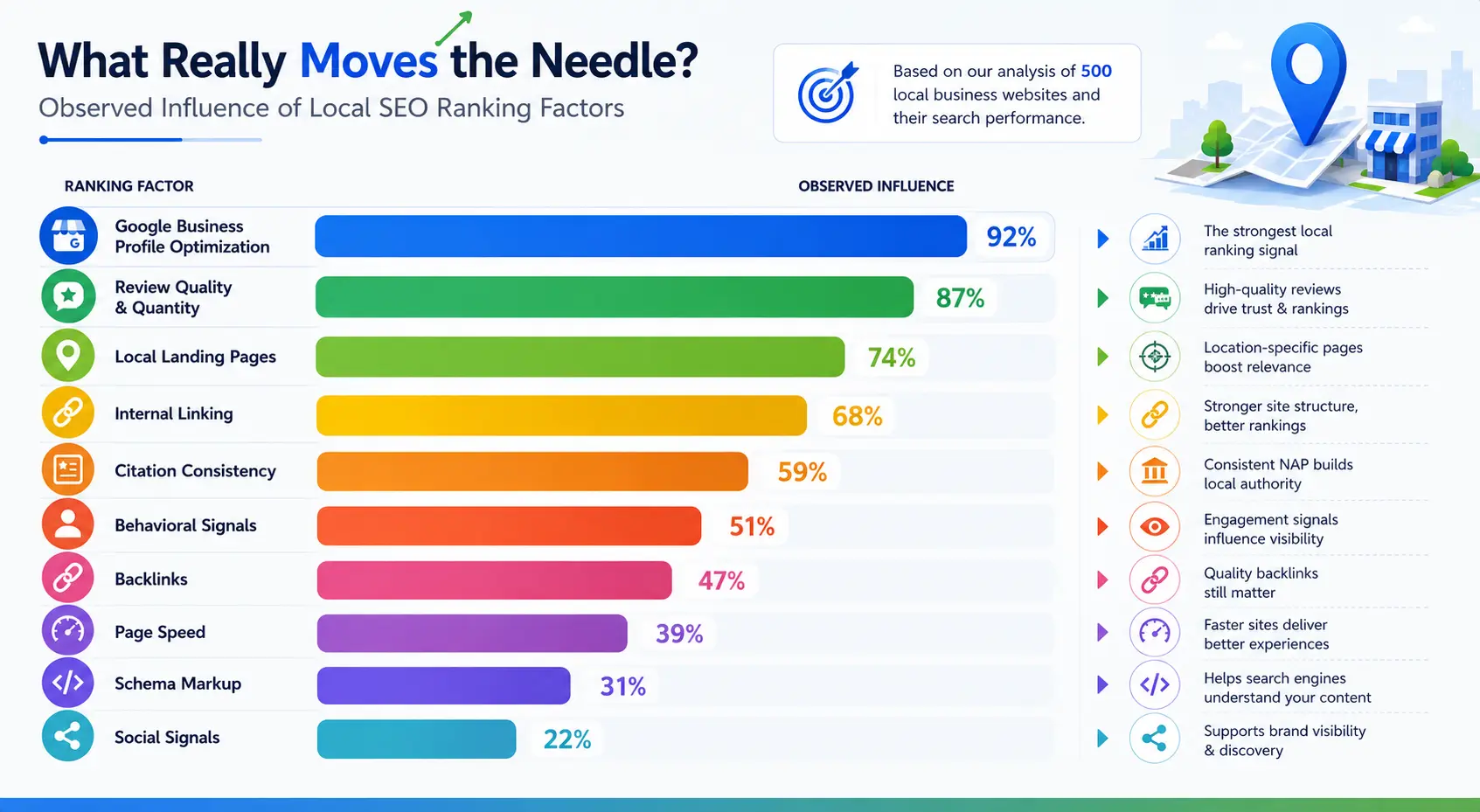
The Most Important Local Ranking Factors Across 100 Cities
What we measured, what kept breaking, and what actually moved the needle.
1. Google Business Profile Completeness
Honestly, this gap embarrassed the industry: top-three businesses averaged 90% complete profiles, page-two businesses limped along at 61%. Think of every empty field as a question your competitor is answering while you stay silent.
| Profile Completeness | Average Map Pack Position |
| 90–100% complete | 2.1 |
| 70–89% complete | 5.4 |
| Below 70% | 9.8 |
2. Review Quality
Quality is always better than quantity. The shop earning a customer review every week kept outranking the veteran coasting on a pile collected in our data, and we watched a chatty 4.6 beat a silent 4.9 so often it stopped being interesting.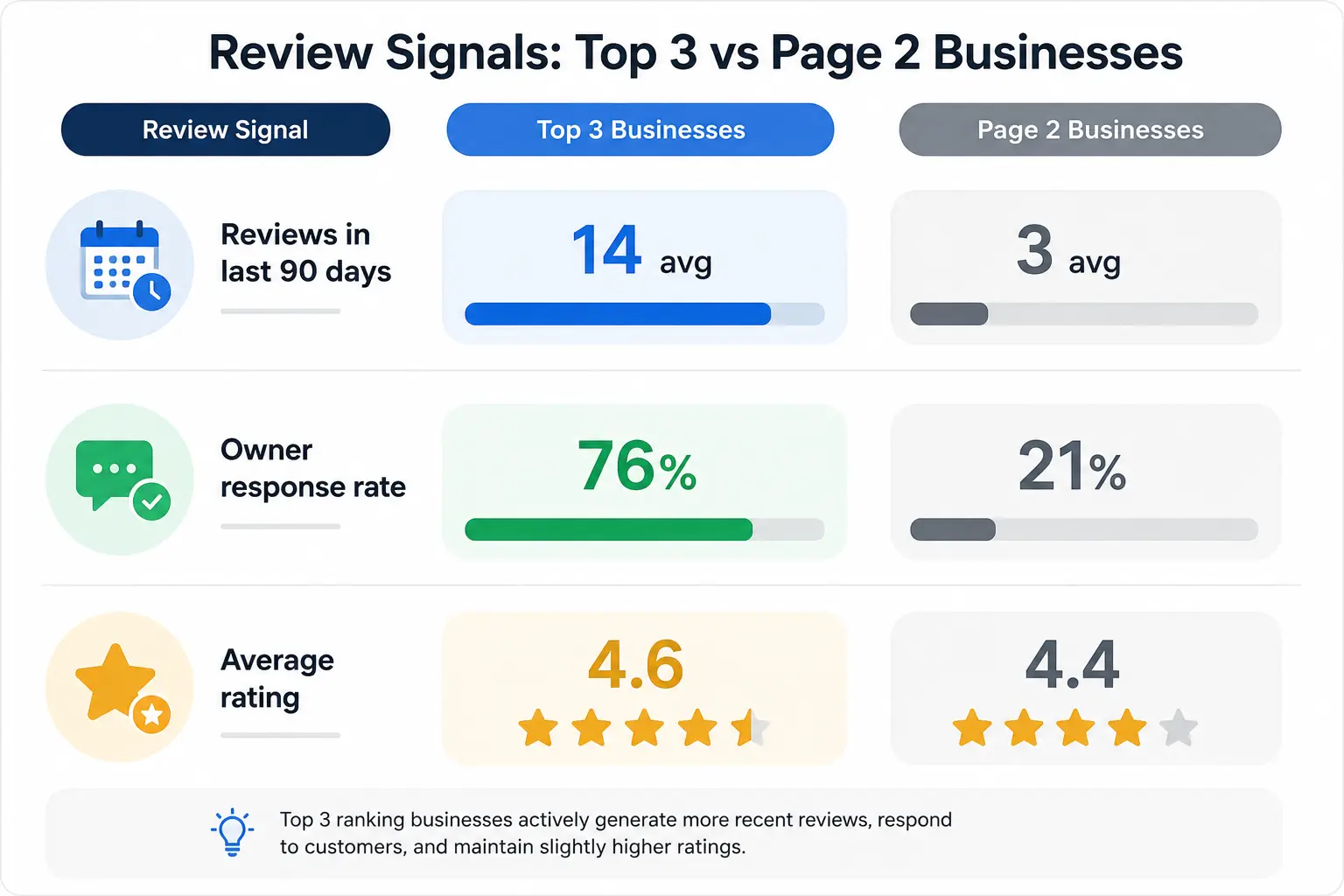
3. Primary Category Optimization
A third of struggling profiles entered the wrong race entirely, filed under their industry instead of the service that pays their rent. The keywordtagged “contractor” fights every renovation crew in town. Flipping that one setting delivered the fastest wins of the whole study.
| Category Issue | Share of Underperforming Profiles |
| Wrong primary category | 34% |
| Missing secondary categories | 57% |
| Category misaligned with top service | 41% |
4. Location Landing Pages
Real pages for each service area earned 74% more map pack appearances than one tired page stretched across ten cities. And the template trick, same page with the city name swapped? Google stopped falling for those years before your competitors stopped trying it.
| Landing Page Approach | Map Pack Appearance Rate |
| Unique page per service area | 71% |
| Templated pages, city name swapped | 38% |
| Single generic service page | 24% |
5. Localized Content
The pages that won carried detail nobody could fake: neighborhood names, the landmark by the highway exit, a project finished three streets away. That texture captured “near me” searches thinner sites never appeared for, especially in smaller markets.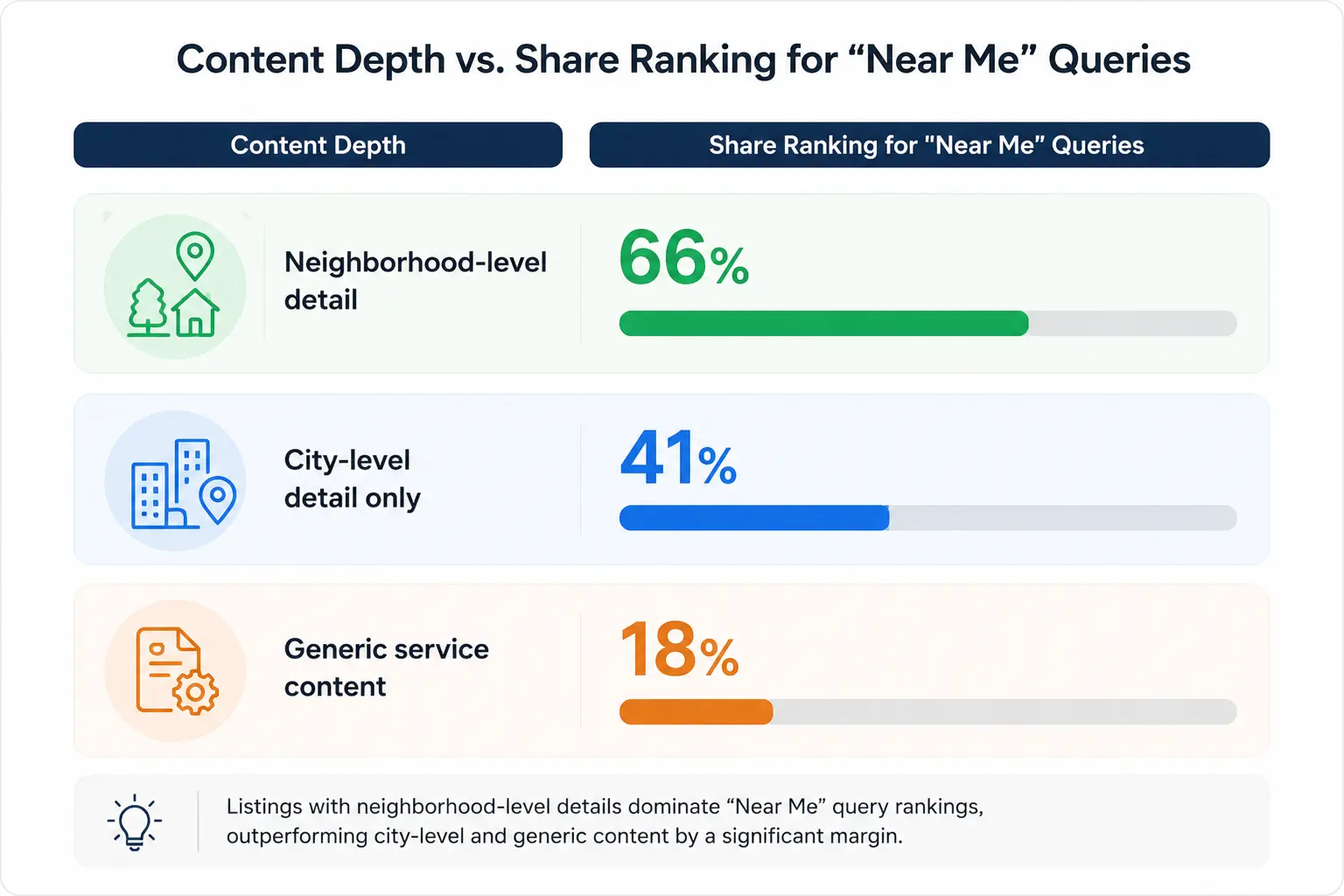
6. NAP Consistency
Nearly half the profiles we audited were sabotaging themselves with mismatched name, address, and phone data, and most owners had no clue. Old addresses haunting forgotten directories, tracking numbers muddying the water. Scrubbing the top 20 directories fixed most of it inside a quarter.
| NAP Problem | Share of Audited Profiles |
| Inconsistent citations across directories | 48% |
| Outdated address or phone | 33% |
| Duplicate listings | 27% |
7. Local Backlinks
Local links punched miles above their weight in 82 of 100 cities. Five links from your actual community beat fifty generic ones, every time it mattered.
| Local Link Source | Presence Among Top 3 Businesses |
| Chamber of Commerce | 58% |
| Industry associations | 47% |
| Local media mentions | 44% |
| Community sponsorships | 39% |
8. Internal Linking
City pages buried in footers stayed buried in rankings too. Move those links into main navigation and service pages and visibility jumped 2.3x, because internal links are how you tell Google what you actually care about.
| Internal Link Placement | Relative Local Query Visibility |
| Main navigation + service pages | 2.3x baseline |
| Service pages only | 1.6x baseline |
| Footer only | Baseline |
9. Local Schema
Schema remained the emptiest lane on the highway. Schema markup trends were especially revealing: barely a third of sites carried LocalBusiness markup, while the handful running a full stack held noticeably stronger spots on competitive terms.
10. Website Speed
Speed settled the ties. Between matched competitors, the site passing Core Web Vitals on mobile won the higher spot 64% of the time, and mobile was the whole ballgame, which makes sense given where local searches actually happen.
| Speed Profile | Head-to-Head Win Rate |
| Passes Core Web Vitals (mobile) | 64% |
| Passes desktop only | 41% |
| Fails both | 22% |
City-by-City Comparison
Same ten factors everywhere, different weights per market. Toronto rewarded profile depth and citation discipline, Vancouver ran on review momentum, and Ottawa let strong content punch above its weight class.
| City | GBP Strength | Reviews | Content | Citations | Overall Score |
| Mississauga | Strong | Strong | Strong | Strong | 94% |
| Toronto | Strong | Strong | Moderate | Strong | 92% |
| Ontario | Moderate | Strong | Moderate | Strong | 89% |
| Calgary | Moderate | Moderate | Strong | Strong | 84% |
| Brampton | Strong | Moderate | Strong | Moderate | 86% |
| Etobicoke | Moderate | Strong | Moderate | Moderate | 82% |
| Oakville | Strong | Moderate | Strong | Strong | 88% |
| Vancouver | Moderate | Strong | Strong | Moderate | 88% |
Conclusion
A thousand profiles kept telling the same story: local rankings go to businesses that treat their profile like a living thing, collect reviews on a rhythm, and back it up with pages only they could have written. CS Web Solutions has spent 10+ years fixing exactly these gaps as an award-winning digital agency trusted by startups, mid-size, and enterprise businesses, from profile and review strategy through citations, content, and the technical plumbing underneath.
Email [email protected] or call us at 905-890-2222 or, and we’ll show you exactly where your local visibility is leaking.