Every SEO agency Toronto enterprises hire to fix a visibility problem faces the same temptation: skip the audit, start executing, show activity fast. We stopped doing that years ago, because activity without diagnosis is how six-month engagements produce nothing.
10+ years of working with enterprise organizations, growing businesses, and startups taught us this:the audit is not the thing you do before the work. The audit is the work. Everything after it is just implementation.
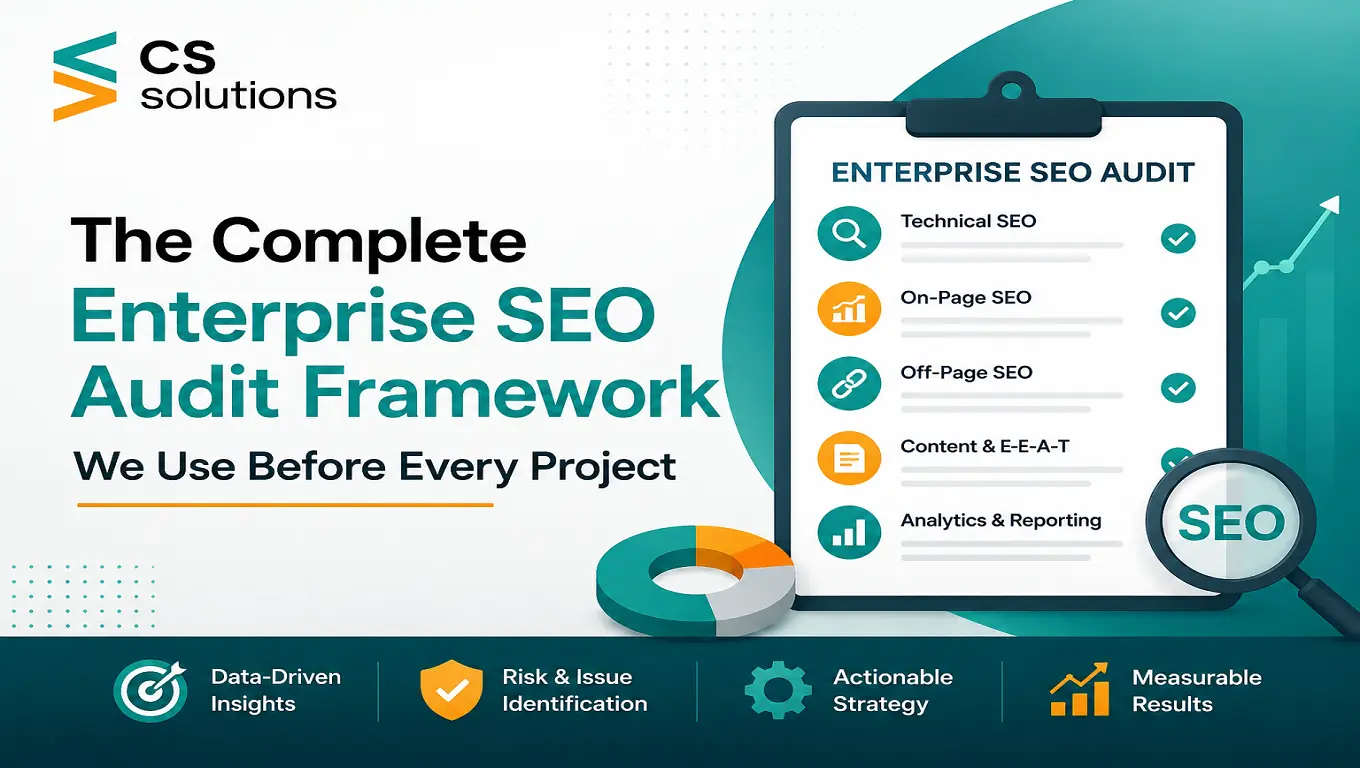
What Are Enterprise SEO Audits?
A regular audit crawls a site, exports a spreadsheet, and highlights some errors. Enterprise SEO for large businesses breaks that model completely, because at enterprise scale, one mistake never stays one mistake. An enterprise audit exists to find these problems while they are still findings, before they become revenue conversations nobody in the room can explain.
How CS Web Solutions Conducts Enterprise SEO Audits
Four phases, run in order, each with its own tools and its own deliverable someone can actually act on.
Phase | What We Are Checking | Key Tools |
1. Technical Health | Crawlability, indexation, crawl budget, JS rendering, architecture, Core Web Vitals, schema | Screaming Frog, Google Search Console, Lighthouse, log file analyser |
2. Content Performance | Keyword targeting, cannibalization, thin content, content gaps, E-E-A-T, AI retrieval readiness | Ahrefs, Semrush, GA4, Google Search Console |
3. Link Equity | Backlink health, internal equity flow, competitor benchmarking, toxic link cleanup | Ahrefs, Semrush, Screaming Frog |
4. Audit to Action | Prioritization, stakeholder reporting, 12-month roadmap with budgets | Google Sheets, GA4, project management tools |
Phase 1: Technical Health Audit
We have perfected our technical seo checklist over hundreds of projects and we always start with what Googlebot does, and not what it should do.
- Crawlability and log file analysis: How the crawler really moves through your site, straight from the server logs
- Indexation and crawl budget: Which pages Google is skipping and why the budget is being spent on URLs that will never convert
- Technical errors: Redirect chains, broken links, and status code problems that templates multiply by the thousands
- JavaScript rendering: What the page looks like to a human versus a crawler, because on React and Angular builds those are often two different pages
- Architecture and internal linking: Where link equity flows and where it pools in places that never earned it
- Core Web Vitals: Measured at template level, because every homepage looks good and almost nothing else does
- Mobile friendliness: Tap targets, viewports, and content parity with desktop
- Metadata and schema: Titles, descriptions, and structured data checked across every template
Phase 2: Content Performance Audit
Thousands of pages need reviewing, and ai powered seo audit strategies make that possible without pretending a sample tells the whole story.
- Audit by page type: Products, categories, blog posts, and location pages each get their own analysis, because averaging them hides everything
- Cannibalization: Where multiple pages compete for the same query and lose together
- Duplicate and thin content: Near-duplicates, boilerplate templates, and pages too shallow to win anything worth winning
- H1 tags: Enterprise CMS platforms create heading problems at scale, and nobody notices until we show them
- Content gaps: Queries your competitors rank for that your site never addressed
- E-E-A-T evaluation: The credibility signals separating cited content from ignored content
- AI retrieval readiness: Whether ChatGPT, Gemini, and Google AI Overviews can actually extract answers from your pages, because organic and AI search now feed from the same content
Phase 3: Backlink and Link Equity Audit
An enterprise link audit reveals to a company where it wins, but quietly loses where its competition is winning while no one is watching.
- High-quality backlinks: Which referring domains still matter, and which are remnants of the old SEO economy
- Source diversity: Whether the profile leans dangerously on one link type
- Anchor text: Over-optimized patterns that create risk at scale
- Link velocity: Whether acquisition looks natural over time or has spikes that need explaining
- Equity distribution: Whether authority from strong backlinks actually reaches the pages that need it
- Competitor benchmarking: The link sources your best rivals earned that you never pursued
- Toxic links: The ones actively working against you, with a disavow case built where needed
Phase 4: Moving From Audit to Action
An audit that lives in a PDF and dies in a PDF is an expensive way to feel productive. This phase turns findings into decisions.
- Prioritize by business impact: Issues ranked by the revenue attached to fixing them, never by how technically interesting they are
- Stakeholder communication: One version a developer can execute from, one version a CFO can understand. Those are different documents and pretending otherwise wastes both audiences’ time
- 12-month roadmap: Work sequenced across four quarters with budget estimates, so the team always knows what comes next and why it matters
Conclusion
CS Web Solutions is a Semrush and Ahrefs certified seo company toronto and Mississauga enterprises, startups, and midsized businesses have trusted for 10+ years, and every engagement we run starts exactly this way. As a local seo agency toronto businesses also call for location-level visibility, we bring the same discipline to both scales. Call 905-890-2222 or email [email protected] and tell us what your site is dealing with.
Frequently Asked Questions
How is an enterprise SEO audit different from a regular SEO audit?
Where standard audits take on hundreds of URLs and page-level issues, enterprise seo audits cover thousands of URLs, template level pain points, crawl budgets and pages that require JS-rendering as well as stakeholder reporting.
How long does an enterprise SEO audit take to complete?
As for how long it takes, 3-6 weeks for most enterprise sites! This depends on template complexity, size and access to analytics (where required).
How often should you run an enterprise SEO audit?
A full audit annually, plus a targeted technical audit each quarter, because enterprise sites change fast enough for problems to compound between reviews.
Do I need a separate SEO and GEO enterprise audit?
Yes. SEO audits check ranking signals; GEO audits check AI citation readiness, entity structure, and structured data for generative surfaces.
How do I contact CS Web Solutions for an enterprise SEO audit?
Call 905-890-2222 or write to [email protected] and we will map the audit based on your site size, goals and priorities.

Vin Sonpal is based in Mississauga, Ontario, and is the founder of CS Web Solutions, established in 2015. He works across web, mobile, and digital platforms, helping businesses build online systems that are practical, scalable, and designed to support long-term growth.